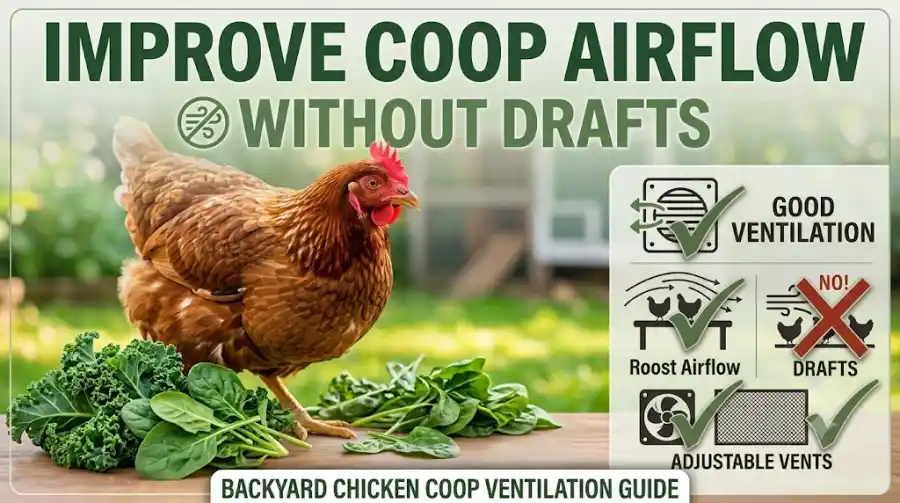
When people search for backyard chicken coop ventilation, they usually want a practical answer they can use today—not a vague list of tips. Backyard Chicken Coop Ventilation is about How to Improve Airflow Without Drafts should be approached as a management question: what does the animal need, what changes should an owner watch for, and when is a normal home-care problem becoming a veterinary or husbandry concern?
Backyard chickens need more than feed and a coop. Ventilation, shade, clean water, predator protection, balanced layer nutrition, litter management and observation of flock behavior all affect welfare and productivity. The best plan is therefore not one-size-fits-all. Age, body condition, workload, environment, diet, climate and previous health problems can all change the right approach.
What this means for chickens
The practical goal with backyard chicken coop ventilation is to create a repeatable routine rather than chase a single “best” trick. Start with the animal’s normal baseline, make one sensible change at a time, and watch the response. If the animal has another medical condition, is pregnant, is very young or old, or is receiving treatment, the plan should be individualized with a veterinarian or qualified animal-health professional.
One useful way to think about the problem is to separate prevention, observation and response. Prevention means providing the correct environment and diet before a problem develops. Observation means noticing changes early. Response means knowing which changes can be monitored and which require professional help. This approach is more reliable than waiting until a symptom is severe and then trying several remedies at once.
Housing is part of health
An enclosure is not just a container. It controls temperature, humidity, movement, sleep, sanitation, feeding access and the animal’s ability to avoid stress. The correct setup depends on species, age, size and climate.
For an owner, the most useful habit is consistency. Check the same basic points at roughly the same time each day, keep the environment predictable, and compare the animal with its own normal behavior rather than with photographs or advice about a different individual. If something changes, note when it started, whether it is getting better or worse, and whether appetite, drinking, movement or behavior changed at the same time. That information can be far more valuable than a guess about the diagnosis.
Size and usable space
Minimum dimensions should not be treated as a goal when more safe space is practical. Consider usable floor area, climbing or flight space where relevant, hiding places, feeding stations and the ability to move away from heat or other animals.
For an owner, the most useful habit is consistency. Check the same basic points at roughly the same time each day, keep the environment predictable, and compare the animal with its own normal behavior rather than with photographs or advice about a different individual. If something changes, note when it started, whether it is getting better or worse, and whether appetite, drinking, movement or behavior changed at the same time. That information can be far more valuable than a guess about the diagnosis.
Temperature and humidity need a range
Many species need access to a gradient rather than one uniform temperature. Reptiles are especially dependent on environmental temperature, while small mammals and birds can be vulnerable to overheating and drafts. Measure conditions rather than guessing by touch.
For an owner, the most useful habit is consistency. Check the same basic points at roughly the same time each day, keep the environment predictable, and compare the animal with its own normal behavior rather than with photographs or advice about a different individual. If something changes, note when it started, whether it is getting better or worse, and whether appetite, drinking, movement or behavior changed at the same time. That information can be far more valuable than a guess about the diagnosis.
Cleanliness without harsh chemicals
Remove waste regularly and clean food and water containers frequently. Choose cleaning products that are safe for the species and rinse thoroughly. Ventilation matters because ammonia, dust, smoke and fumes can damage sensitive respiratory systems.
For an owner, the most useful habit is consistency. Check the same basic points at roughly the same time each day, keep the environment predictable, and compare the animal with its own normal behavior rather than with photographs or advice about a different individual. If something changes, note when it started, whether it is getting better or worse, and whether appetite, drinking, movement or behavior changed at the same time. That information can be far more valuable than a guess about the diagnosis.
Enrichment and natural behavior
A good enclosure allows normal behaviors such as foraging, chewing, digging, climbing, bathing, basking, hiding or exploring. Rotate safe enrichment instead of filling the space with random objects that can be swallowed, trapped around limbs or damaged into sharp pieces.
For an owner, the most useful habit is consistency. Check the same basic points at roughly the same time each day, keep the environment predictable, and compare the animal with its own normal behavior rather than with photographs or advice about a different individual. If something changes, note when it started, whether it is getting better or worse, and whether appetite, drinking, movement or behavior changed at the same time. That information can be far more valuable than a guess about the diagnosis.
Safety checks
Inspect doors, mesh, bar spacing, heating equipment, electrical cords, substrate, sharp edges and escape routes. A setup that was safe for a young animal may become unsafe as it grows.
For an owner, the most useful habit is consistency. Check the same basic points at roughly the same time each day, keep the environment predictable, and compare the animal with its own normal behavior rather than with photographs or advice about a different individual. If something changes, note when it started, whether it is getting better or worse, and whether appetite, drinking, movement or behavior changed at the same time. That information can be far more valuable than a guess about the diagnosis.
Quarantine and introductions
When adding a new animal, consider disease risk and social compatibility. Quarantine can be important for some species, and introductions should be gradual rather than forced. Ask a veterinarian about species-specific biosecurity requirements.
For an owner, the most useful habit is consistency. Check the same basic points at roughly the same time each day, keep the environment predictable, and compare the animal with its own normal behavior rather than with photographs or advice about a different individual. If something changes, note when it started, whether it is getting better or worse, and whether appetite, drinking, movement or behavior changed at the same time. That information can be far more valuable than a guess about the diagnosis.
When the enclosure may be causing illness
Repeated respiratory signs, abnormal shedding, foot problems, obesity, poor feather or coat condition, persistent aggression or unexplained appetite changes can sometimes point to husbandry problems. Review the setup and seek professional advice rather than treating symptoms alone.
For an owner, the most useful habit is consistency. Check the same basic points at roughly the same time each day, keep the environment predictable, and compare the animal with its own normal behavior rather than with photographs or advice about a different individual. If something changes, note when it started, whether it is getting better or worse, and whether appetite, drinking, movement or behavior changed at the same time. That information can be far more valuable than a guess about the diagnosis.
Practical checklist
- Know what normal appetite, drinking, activity and behavior look like for this individual.
- Keep food and water clean and appropriate for the species and life stage.
- Check housing, temperature, ventilation, flooring and equipment regularly.
- Make changes gradually when the species and situation allow it.
- Record important changes instead of relying on memory.
- Do not use human medicines or another animal’s prescription without veterinary direction.
- Seek professional help when signs are severe, sudden, persistent or worsening.
Evidence-based guidance worth reading
For additional species-specific context, the University of Arizona Extension: backyard chicken heat is a useful reference: University of Arizona Extension: backyard chicken heat. The University of Minnesota Extension: poultry heat stress also provides helpful background for owners: University of Minnesota Extension: poultry heat stress.
Related Horse Facts
- How to Get Pet Urine Smell Out of Carpet: A Realistic Guide for Pet Owners
- Is Pet Insurance Worth It? A Cost-Benefit Analysis for Bird Owners
Frequently Asked Questions
Is this advice suitable for every chickens?
No. Species, age, size, climate, diet and health history can change what is appropriate. Use this guide as general education and adapt the plan to the individual animal.
What is the first thing I should check?
Start with the basics: appetite, water intake, behavior, breathing, movement, droppings or manure, and the condition of the housing. These observations establish whether the issue is isolated or part of a wider change.
When should I contact a veterinarian?
Contact a veterinarian when the animal is seriously unwell, rapidly deteriorating, unable to eat or drink normally, struggling to breathe, collapsing, showing severe pain, or displaying another emergency sign. Earlier advice is preferable when you are uncertain.
Can I fix the problem with a supplement?
Sometimes nutrition is part of prevention, but a supplement should not be treated as a universal solution. The correct first step is to identify the animal’s needs and the cause of the problem.
Backyard Chicken Coop Ventilation: How to Improve Airflow Without Drafts is best approached as a management plan rather than a single trick. Give the animal an appropriate environment, balanced nutrition, clean water, regular observation and species-appropriate enrichment. When something changes, act on the change early and use professional veterinary or husbandry guidance when the situation is beyond routine home care. Good animal care is usually built from many small, consistent decisions—and those decisions become much easier when you know what “normal” looks like.