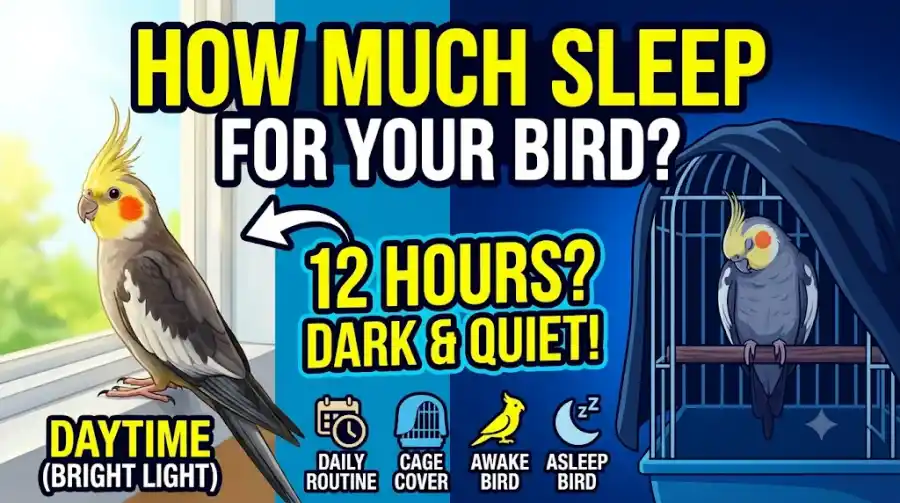
When people search for how much sleep does a pet bird need, they usually want a practical answer they can use today—not a vague list of tips. How Much Sleep Does a Pet Bird Need? Light, Darkness and Daily Routine should be approached as a management question: what does the animal need, what changes should an owner watch for, and when is a normal home-care problem becoming a veterinary or husbandry concern?
Pet birds are intelligent, active animals whose health is strongly influenced by diet, housing, sanitation, sleep, exercise and environmental safety. Birds can deteriorate quickly when ill, so subtle changes in appetite, posture, droppings, breathing or activity deserve attention. The best plan is therefore not one-size-fits-all. Age, body condition, workload, environment, diet, climate and previous health problems can all change the right approach.
What this means for pet birds
The practical goal with how much sleep does a pet bird need is to create a repeatable routine rather than chase a single “best” trick. Start with the animal’s normal baseline, make one sensible change at a time, and watch the response. If the animal has another medical condition, is pregnant, is very young or old, or is receiving treatment, the plan should be individualized with a veterinarian or qualified animal-health professional.
One useful way to think about the problem is to separate prevention, observation and response. Prevention means providing the correct environment and diet before a problem develops. Observation means noticing changes early. Response means knowing which changes can be monitored and which require professional help. This approach is more reliable than waiting until a symptom is severe and then trying several remedies at once.
Behavior is communication
Behavior problems are often described as stubbornness, bad habits or attention seeking, but behavior can be influenced by fear, pain, boredom, social conflict, environment and learning history. Start by asking what the animal may be communicating.
For an owner, the most useful habit is consistency. Check the same basic points at roughly the same time each day, keep the environment predictable, and compare the animal with its own normal behavior rather than with photographs or advice about a different individual. If something changes, note when it started, whether it is getting better or worse, and whether appetite, drinking, movement or behavior changed at the same time. That information can be far more valuable than a guess about the diagnosis.
Look for the trigger
Write down what happens immediately before, during and after the behavior. Location, time of day, people present, other animals, noise, food and handling can reveal patterns. A trigger that appears small to an owner may be significant to the animal.
For an owner, the most useful habit is consistency. Check the same basic points at roughly the same time each day, keep the environment predictable, and compare the animal with its own normal behavior rather than with photographs or advice about a different individual. If something changes, note when it started, whether it is getting better or worse, and whether appetite, drinking, movement or behavior changed at the same time. That information can be far more valuable than a guess about the diagnosis.
Change the environment before demanding more training
Give the animal a predictable routine, safe retreat, appropriate exercise and species-specific enrichment. Reduce unnecessary stressors and make desired behaviors easy to perform. Environmental management is often the foundation for successful training.
For an owner, the most useful habit is consistency. Check the same basic points at roughly the same time each day, keep the environment predictable, and compare the animal with its own normal behavior rather than with photographs or advice about a different individual. If something changes, note when it started, whether it is getting better or worse, and whether appetite, drinking, movement or behavior changed at the same time. That information can be far more valuable than a guess about the diagnosis.
Use reward-based learning
Reward-based training helps the animal understand what behavior earns a desirable outcome. Keep sessions short and repeatable. Avoid punishment that creates fear or suppresses warning signals, especially when the underlying problem may be anxiety or pain.
For an owner, the most useful habit is consistency. Check the same basic points at roughly the same time each day, keep the environment predictable, and compare the animal with its own normal behavior rather than with photographs or advice about a different individual. If something changes, note when it started, whether it is getting better or worse, and whether appetite, drinking, movement or behavior changed at the same time. That information can be far more valuable than a guess about the diagnosis.
Social needs are species-specific
Some animals need companionship; others prefer controlled space or solitary housing. Do not assume that adding another animal will solve boredom or loneliness. Introductions, group size, sex, age and resources can all influence compatibility.
For an owner, the most useful habit is consistency. Check the same basic points at roughly the same time each day, keep the environment predictable, and compare the animal with its own normal behavior rather than with photographs or advice about a different individual. If something changes, note when it started, whether it is getting better or worse, and whether appetite, drinking, movement or behavior changed at the same time. That information can be far more valuable than a guess about the diagnosis.
Watch for a medical cause
A sudden behavior change, new aggression, hiding, vocalization, house-soiling, feather or hair changes, reduced movement or sleep disruption can sometimes accompany pain or illness. If behavior changes abruptly, veterinary assessment should be part of the plan.
For an owner, the most useful habit is consistency. Check the same basic points at roughly the same time each day, keep the environment predictable, and compare the animal with its own normal behavior rather than with photographs or advice about a different individual. If something changes, note when it started, whether it is getting better or worse, and whether appetite, drinking, movement or behavior changed at the same time. That information can be far more valuable than a guess about the diagnosis.
Build a routine you can maintain
A complicated program that works for three days is less useful than a simple routine you can follow for months. Use consistent feeding, exercise, enrichment and rest periods and measure small improvements rather than expecting an instant transformation.
For an owner, the most useful habit is consistency. Check the same basic points at roughly the same time each day, keep the environment predictable, and compare the animal with its own normal behavior rather than with photographs or advice about a different individual. If something changes, note when it started, whether it is getting better or worse, and whether appetite, drinking, movement or behavior changed at the same time. That information can be far more valuable than a guess about the diagnosis.
When professional help is appropriate
Veterinary behavior support or an experienced species-appropriate trainer can be valuable when behavior is dangerous, severe, persistent or linked to fear. Early help is usually easier than allowing a problem to become a deeply practiced habit.
For an owner, the most useful habit is consistency. Check the same basic points at roughly the same time each day, keep the environment predictable, and compare the animal with its own normal behavior rather than with photographs or advice about a different individual. If something changes, note when it started, whether it is getting better or worse, and whether appetite, drinking, movement or behavior changed at the same time. That information can be far more valuable than a guess about the diagnosis.
Practical checklist
- Know what normal appetite, drinking, activity and behavior look like for this individual.
- Keep food and water clean and appropriate for the species and life stage.
- Check housing, temperature, ventilation, flooring and equipment regularly.
- Make changes gradually when the species and situation allow it.
- Record important changes instead of relying on memory.
- Do not use human medicines or another animal’s prescription without veterinary direction.
- Seek professional help when signs are severe, sudden, persistent or worsening.
Evidence-based guidance worth reading
For additional species-specific context, the Merck Veterinary Manual: pet bird nutrition is a useful reference: Merck Veterinary Manual: pet bird nutrition. The Merck Veterinary Manual: pet bird health also provides helpful background for owners: Merck Veterinary Manual: pet bird health.
Related Horse Facts
- How to pet a cat: a guide to feline affection
- Proper Cage Setup & Size: Creating a Safe and Stimulating Environment for Your Pet Bird
Frequently Asked Questions
Is this advice suitable for every pet birds?
No. Species, age, size, climate, diet and health history can change what is appropriate. Use this guide as general education and adapt the plan to the individual animal.
What is the first thing I should check?
Start with the basics: appetite, water intake, behavior, breathing, movement, droppings or manure, and the condition of the housing. These observations establish whether the issue is isolated or part of a wider change.
When should I contact a veterinarian?
Contact a veterinarian when the animal is seriously unwell, rapidly deteriorating, unable to eat or drink normally, struggling to breathe, collapsing, showing severe pain, or displaying another emergency sign. Earlier advice is preferable when you are uncertain.
Can I fix the problem with a supplement?
Sometimes nutrition is part of prevention, but a supplement should not be treated as a universal solution. The correct first step is to identify the animal’s needs and the cause of the problem.
How Much Sleep Does a Pet Bird Need? Light, Darkness and Daily Routine is best approached as a management plan rather than a single trick. Give the animal an appropriate environment, balanced nutrition, clean water, regular observation and species-appropriate enrichment. When something changes, act on the change early and use professional veterinary or husbandry guidance when the situation is beyond routine home care. Good animal care is usually built from many small, consistent decisions—and those decisions become much easier when you know what “normal” looks like.