If you have ever checked your horse late at night and found it standing quietly with its eyes partly closed, you may have wondered whether it is actually sleeping. Horses have a different sleep routine from humans. They can rest while standing, take several short naps throughout the day and night, and lie down when they need deeper stages of sleep.
Understanding how much sleep horses need is more than an interesting animal fact. Sleep is an important part of a horse’s physical comfort, recovery and overall welfare. Changes in sleeping habits can sometimes point to discomfort, an unsuitable stable environment or an underlying health problem.
In this guide, we will look at normal horse sleeping patterns, the difference between standing rest and REM sleep, why horses lie down, and what owners can do to support better rest.
How Many Hours Do Horses Sleep Each Day?
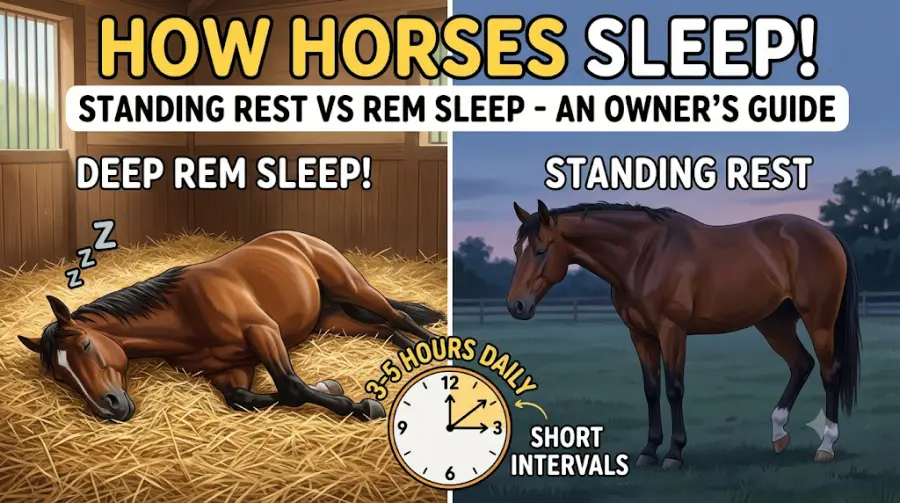
Most adult horses sleep for approximately three to five hours in a 24-hour period, although individual routines vary. They do not usually sleep in one long, uninterrupted session like people. Instead, their rest is divided into several shorter periods.
A horse may doze briefly while standing, become more alert when something changes in its surroundings, and return to resting when it feels safe. Some of its sleep occurs at night, but horses can also rest during daylight hours.
The exact amount of sleep depends on several factors, including:
- Age and individual temperament
- Housing and turnout arrangements
- Comfort of the bedding and resting area
- Social relationships with other horses
- Pain, illness or physical discomfort
- Noise, lighting and disturbances
- Changes in routine or surroundings
The important point is that there is no single daily sleep target that applies perfectly to every horse. Owners should learn their horse’s normal routine and pay attention to meaningful changes.
Can Horses Sleep Standing Up?
Yes. Horses can enter a light stage of sleep while standing. Their bodies have a specialised system of tendons and ligaments in the limbs, commonly called the stay apparatus. This system helps support their weight without requiring continuous muscular effort.
This ability is useful for an animal that evolved to remain alert to potential danger. A horse resting on its feet can respond more quickly to a disturbance than one lying on the ground.
However, standing sleep does not provide every stage of sleep a horse needs. A horse can doze and experience slow-wave sleep while standing, but it must lie down to achieve REM sleep.
This is why seeing a horse standing quietly with its head lowered does not necessarily mean it has completed all its sleep needs.
Why Do Horses Lie Down to Sleep?
Horses lie down because some important sleep stages require the body to be in a recumbent position. They may lie on their chest with their legs tucked underneath them, or stretch out onto their sides.
A horse generally needs to feel sufficiently comfortable and secure before it lies down. As a prey animal, it may be reluctant to rest on the ground if it feels threatened or cannot easily get back to its feet.
Lying down can also help owners understand whether a horse has access to a suitable resting environment. A horse that never appears to lie down may be experiencing discomfort, social pressure, unsuitable bedding or another problem.
Occasional observation is not enough to establish a sleep disorder, but a persistent change deserves attention.
What Is REM Sleep in Horses?
REM stands for rapid eye movement. It is a stage of sleep associated with activity in the brain and temporary relaxation of most skeletal muscles.
Horses need to lie down to achieve REM sleep because the muscle relaxation that occurs during this stage makes standing unsafe. If a horse attempts to enter REM sleep while upright, it may lose postural support and buckle at the knees.
This explains why a comfortable place to lie down is essential. A horse that can doze while standing but cannot settle on the ground may not be getting adequate REM sleep.
REM sleep is only one part of the overall sleep cycle, but it is an important part. Owners should not assume that a horse is getting enough rest simply because it appears quiet during the day.
How Can You Tell If a Horse Is Sleeping?
Horse sleep can be easy to miss because some resting behaviours look similar to ordinary standing.
Common signs of light rest or drowsiness include:
- A lowered head and relaxed neck
- Partly closed eyes
- Relaxed facial muscles
- One hind leg resting with reduced weight on it
- A quiet, still posture
- Reduced attention to minor disturbances
When lying down, a horse may rest with its legs folded underneath its body or stretch out on its side.
These signs are useful observations, not a diagnosis. A horse standing with its head lowered may be resting, but unusual dullness or reduced responsiveness can also indicate illness. Consider the horse’s overall behaviour, appetite, movement and normal routine.
Why Might a Horse Not Lie Down?
A horse that rarely lies down may not have a suitable opportunity to rest. There can be several explanations, and they should not all be treated as behavioural problems.
1. Uncomfortable bedding
Hard, wet, dirty or insufficient bedding may discourage a horse from lying down. The resting area should provide enough space and a comfortable surface.
2. Pain or stiffness
Joint pain, back discomfort, hoof pain and other musculoskeletal problems can make lying down or getting back up difficult. Older horses may be particularly affected by mobility problems.
3. Feeling unsafe
A horse may avoid lying down if it feels exposed, frightened or unsettled. Loud noises, unfamiliar surroundings and frequent disturbances can interfere with resting behaviour.
4. Social pressure
In group housing, a horse may not feel comfortable resting if other horses repeatedly approach, threaten or disturb it. Adequate space and compatible companions matter.
5. Changes in routine
Moving to a new stable, changing turnout arrangements or travelling can temporarily alter sleeping habits. Some horses take time to become comfortable in a new environment.
If the horse’s reluctance to lie down is persistent, or it is showing signs of pain, weakness or unusual daytime drowsiness, arrange a veterinary assessment.
Signs Your Horse May Not Be Getting Enough Sleep
Sleep disruption can affect a horse’s behaviour and welfare. One sign alone does not prove sleep deprivation, but repeated changes deserve attention.
Watch for:
- Repeatedly nodding off while standing
- Knees buckling or the horse appearing to stumble while dozing
- Unusual daytime drowsiness
- Reduced willingness to work or interact
- Frequent changes in resting position without settling
- A noticeable reduction in lying-down behaviour
- New irritability or changes in normal behaviour
Some horses with inadequate REM sleep may experience episodes in which their knees buckle as they begin to fall asleep while standing. This can cause them to stumble or injure themselves.
Do not assume that every episode of stumbling is sleep-related. Neurological, musculoskeletal and other medical conditions can also affect balance. A veterinarian should investigate repeated or unexplained episodes.
How to Create a Comfortable Sleeping Environment
Owners cannot force a horse to sleep, but they can make the resting area safer and more comfortable.
Provide clean, comfortable bedding
Choose bedding that is appropriate for the horse, stable and management system. Keep it dry, clean and deep enough to create a comfortable place to lie down.
Make sure there is enough space
The horse should have sufficient room to lie down, stretch its legs and get back up without hitting walls, doors or equipment.
Reduce unnecessary disturbances
Avoid repeated interruptions during normal resting periods. Check that stable doors, machinery and nearby activities are not creating avoidable noise.
Provide a sense of security
A familiar environment and compatible social contact can help horses feel more settled. If horses are housed together, make sure each animal has enough space to rest without being pushed away.
Monitor comfort and mobility
A horse that struggles to lie down or rise may need a veterinary examination. Do not treat persistent reluctance as simply a habit or personality trait.
For more stable-management advice, you can connect this article with your existing guides on horse bedding choices, keeping a horse stall dry and senior horse care. Confirm each destination is still live before publishing the links.
Do Foals Sleep More Than Adult Horses?
Foals have different resting needs from mature horses. Young foals often spend more time resting and lying down, especially during the early stages of life. As they grow, their activity and sleep patterns gradually change.
A healthy foal should be able to lie down and rise without difficulty. Owners should pay attention to changes in nursing, activity, alertness and interaction with the mare.
If a foal is unusually weak, cannot stand, is reluctant to nurse or seems difficult to wake, contact a veterinarian promptly. Do not dismiss these signs as normal sleepiness.
Do Older Horses Have Different Sleeping Habits?
Older horses may experience changes in their ability to lie down and get back up. Arthritis, stiffness, hoof pain and other age-related problems can make resting on the ground less comfortable.
Some older horses may therefore spend less time lying down. This matters because standing rest alone does not provide REM sleep.
If an older horse stops lying down, investigate the reason rather than assuming it is simply part of ageing. A veterinarian can assess mobility, pain and other health factors. Improvements to bedding, space and stable access may also help, depending on the individual horse’s needs.
When Should You Contact a Veterinarian?
Contact your veterinarian if your horse shows a persistent change in sleeping behaviour, repeatedly struggles to lie down or rise, or appears excessively sleepy during the day.
Seek prompt veterinary advice if you notice:
- Repeated stumbling or knee-buckling episodes
- Signs of pain when lying down or getting up
- Sudden changes in alertness or coordination
- Unexplained weakness or unusual behaviour
- Reduced appetite alongside changes in activity
- Injuries that may have occurred while falling or getting up
A veterinarian can look for pain, mobility problems, neurological conditions and environmental factors that may be interfering with rest.
Frequently Asked Questions
How much sleep do horses need in 24 hours?
Most adult horses sleep for roughly three to five hours per day. Their sleep is divided into multiple short periods, and the amount varies between individuals.
Do horses sleep standing up?
Yes. Horses can doze and experience slow-wave sleep while standing. However, they must lie down to achieve REM sleep.
How long can a horse go without lying down?
There is no safe universal time limit that owners should use. A horse that consistently avoids lying down may be at risk of inadequate REM sleep. Persistent changes should be investigated by a veterinarian.
Do horses sleep at night or during the day?
Horses can rest during both daytime and nighttime. Their sleep is spread across several episodes rather than being limited to one long nighttime period.
Why does my horse’s knee buckle while standing?
One possible explanation is that the horse is beginning to fall asleep and entering a deeper sleep stage without lying down. However, repeated buckling or stumbling can have other medical causes and should be assessed by a veterinarian.
Do horses need a bed to sleep?
Horses need a safe, comfortable resting surface rather than a human-style bed. Suitable bedding, enough space and a secure environment can encourage normal lying behaviour.
Horses have a distinctive sleep routine that allows them to rest while remaining alert to their surroundings. They can doze while standing, but lying down is essential for REM sleep. That makes a comfortable and secure resting area an important part of everyday horse care.
Pay attention to your horse’s normal habits. If it stops lying down, repeatedly stumbles while dozing or seems unusually tired, look beyond the behaviour itself and consider whether pain, mobility or environmental conditions are involved.
Good horse care includes more than feeding, grooming and exercise. Giving a horse the opportunity to rest comfortably is also an important part of protecting its health and welfare.