How to Check a Horse’s Digital Pulse and What Changes Mean
A horse’s digital pulse is the pulse of an artery supplying the foot. Learning to find it can help owners notice changes associated with hoof inflammation, injury or pain. It is not a diagnosis by itself, but it is a useful observation when combined with gait, hoof temperature, stance and veterinary examination.
Where is the digital pulse?
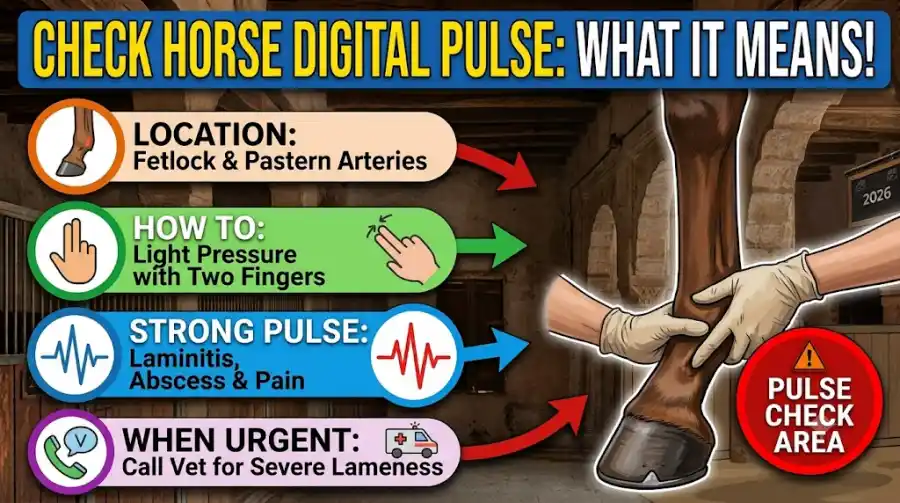
The digital arteries run down the back and sides of the lower limb toward the foot. In many horses, the pulse is easiest to feel around the pastern or fetlock area, beside the deep flexor tendon and near the sesamoid region.
The exact location varies with anatomy, swelling, shoeing and the individual horse. Ask your veterinarian or farrier to show you the best place on your horse.
How to check it
1. Choose a quiet, safe location.
2. Stand beside the limb, not in front of the hoof.
3. Use the pads of your index and middle fingers.
4. Lightly press over the artery until you feel a rhythmic beat.
5. Compare the same location on the opposite limb.
6. Notice the strength, regularity and whether the pulse is easy to find.
7. Record the result if you are monitoring a problem.
Use gentle pressure. Pressing too hard can flatten the artery and make the pulse disappear.
What is normal?
A digital pulse may be faint or difficult to feel in a healthy horse. It can become easier to detect after exercise, in warm conditions or when circulation changes. The most useful comparison is often between matching limbs and with your horse’s usual baseline.
A stronger or bounding pulse can indicate increased blood flow associated with inflammation or pain in the foot. It does not automatically mean laminitis, and a faint pulse does not rule out serious disease.
What can cause a stronger digital pulse?
Possible causes include:
– Laminitis
– Hoof abscess
– Bruising or sole pain
– Injury to the foot
– Inflammation of structures within the hoof
– Local swelling or trauma
– Recent exercise or heat
The location, degree of pain and other signs help determine the likely cause.
Digital pulse and laminitis
Laminitis is a painful condition involving the structures that support the coffin bone. Warning signs can include a bounding digital pulse, increased hoof warmth, reluctance to move, a short stiff gait, shifting weight, a rocked-back stance or difficulty turning.
Some horses show subtle signs. Others become severely painful. If laminitis is suspected, call your veterinarian immediately.
Until you receive instructions, keep the horse quiet and avoid unnecessary movement. Deep, supportive footing may be helpful, but ask your veterinarian what footing and first aid are appropriate for the situation.
Digital pulse and hoof abscess
A hoof abscess can cause sudden, intense lameness and may produce a stronger pulse in the affected foot. The horse may point the toe, refuse to bear weight or react strongly when the hoof is handled.
Do not dig into the sole or use repeated soaking and poulticing without professional guidance. Your farrier or veterinarian can help locate and treat the abscess while ruling out other causes of lameness.
Why comparison matters
A pulse that feels strong in all four feet after exercise is different from a pulse that is markedly stronger in one foot while the horse is lame. Compare:
– Left front with right front
– Left hind with right hind
– Affected limb with the horse’s normal baseline
– Pulse strength before and after rest
Always interpret the finding with the horse’s behavior and movement.
Other signs to check
When checking the digital pulse, also observe:
– Hoof temperature compared with other feet
– Lameness or shortened stride
– Reluctance to turn
– Weight shifting
– Swelling
– Sensitivity to hoof testers
– Changes in appetite or attitude
These observations can help the vet or farrier understand the pattern, but they do not replace diagnostic testing.
When is it urgent?
Call your veterinarian promptly for a strong digital pulse combined with:
– Sudden or severe lameness
– Heat in multiple feet
– A rocked-back stance
– Reluctance to walk
– Recent grain overload or access to lush pasture
– A painful, swollen or injured limb
– Rapid worsening
Laminitis is time-sensitive, so do not wait for the horse to become unable to walk.
Common mistakes
Avoid checking only one foot, pressing too hard, or deciding that a normal pulse rules out disease. Do not repeatedly force a painful horse to walk to “test” the lameness.
Final takeaway
Digital-pulse checking is a simple skill that becomes more useful with practice. Learn your horse’s normal findings, compare matching limbs, and treat sudden changes—especially with pain or lameness—as a reason to contact your veterinarian.
FAQs
Can a healthy horse have a noticeable digital pulse?
Yes. Pulse strength can vary with exercise, temperature and anatomy. A noticeable pulse alone is not diagnostic.
Can I diagnose laminitis by digital pulse?
No. A strong pulse can support concern but cannot confirm the cause. Veterinary examination is needed.
Should I walk a horse with a strong digital pulse?
Do not force movement if the horse is painful or laminitis is suspected. Contact your veterinarian for specific instructions.