While grooming your horse, you may notice a small, rough patch of skin, a hairless area or a lump that was not there before. It may look harmless, but some unusual skin growths deserve closer attention. One important condition horse owners should understand is sarcoids in horses, a common type of equine skin tumour.
Sarcoids can appear in different shapes and sizes. Some look like small warts or flat patches, while others develop into fleshy, irregular growths that may bleed or become damaged. They can occur around the eyes, ears, legs, belly, chest and other parts of the body.
Although sarcoids rarely spread to internal organs, they can be locally aggressive. A growth near an eye may interfere with normal eyelid function, while one beneath a girth or saddle area can make riding uncomfortable.
The important thing is not to panic or try to remove a lump yourself. Other skin conditions can look similar, and inappropriate treatment may make a sarcoid more difficult to manage.
This guide explains the different types of equine sarcoids, their possible causes, warning signs, veterinary diagnosis, treatment options and practical steps owners can take when they discover an unusual growth.
What Are Sarcoids in Horses?
Equine sarcoids are locally invasive skin tumours. They are among the most commonly diagnosed tumours in horses and other equids.
They are strongly associated with bovine papillomavirus, particularly types 1 and 2. Despite the name, this virus is associated with cattle, but it can also be involved in the development of sarcoids in susceptible horses.
Sarcoids usually remain within the skin and surrounding tissues rather than spreading to distant organs. However, this does not mean they are harmless. Some can grow aggressively, damage nearby tissue, become ulcerated and interfere with the horse’s comfort.
A sarcoid may appear as a single growth or as several lesions in different areas.
One horse may have a small, stable-looking patch for a long time, while another may develop a rapidly growing fleshy mass. Their behaviour depends on the type, location and individual characteristics of the lesion.
Six Types of Equine Sarcoids
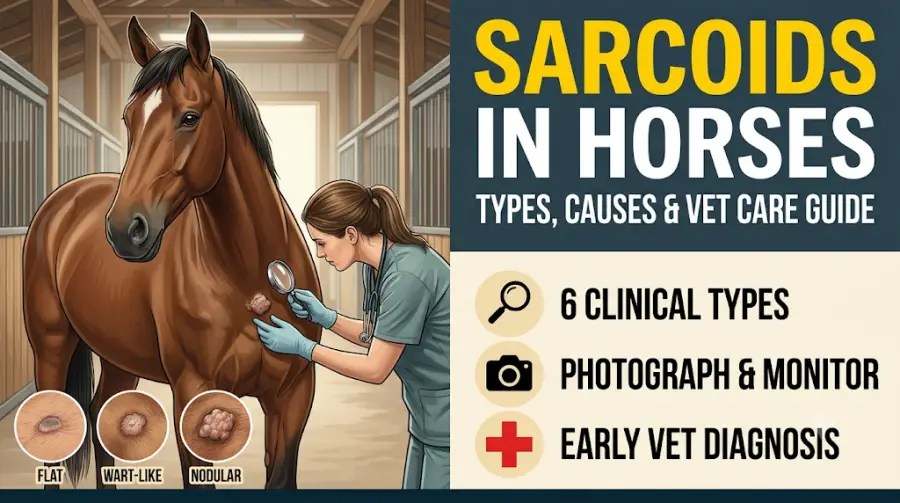
Veterinary references commonly describe six clinical forms. Understanding their appearance can help owners know what to look for, although appearance alone cannot establish a diagnosis.
1. Occult Sarcoids
Occult sarcoids are generally among the flatter forms.
They may look like:
- Small, hairless patches.
- Slightly thickened areas of skin.
- Circular or irregular grey patches.
- Areas with a rough or different skin texture.
They can be mistaken for old scars, minor skin irritation or other superficial conditions.
Because they may not look like obvious tumours, owners sometimes overlook them during routine grooming.
2. Verrucose Sarcoids
Verrucose sarcoids have a rough, wart-like appearance.
Their surface may be:
- Dry and scaly.
- Thickened or crusty.
- Greyish in colour.
- Irregular around the edges.
Some remain relatively flat, while others develop thicker nodules.
They may be confused with fungal skin conditions or other wart-like growths. A veterinary assessment is important before deciding what the lesion is.
3. Nodular Sarcoids
Nodular sarcoids appear as firm lumps beneath or within the skin.
They may have normal-looking skin covering them, or the surface may become damaged and ulcerated.
Some nodules have a narrow attachment, while others have a broad base.
They are commonly found around areas such as the groin, inner thighs and eyelids, although they can develop elsewhere.
4. Fibroblastic Sarcoids
Fibroblastic sarcoids often look more fleshy and aggressive.
They may develop as:
- Raised masses.
- Moist or irregular growths.
- Easily bleeding lesions.
- Ulcerated areas.
- Rapidly enlarging lumps.
These growths can become damaged through rubbing, grooming, flies or contact with equipment.
Because they can be locally invasive, early veterinary attention is particularly important.
5. Mixed Sarcoids
A mixed sarcoid contains features of more than one type.
For example, a horse may have a nodular growth with a rough, wart-like surface or a lesion that changes in appearance over time.
Some horses also develop different types of sarcoids in separate locations.
6. Malevolent Sarcoids
Malevolent sarcoids are extremely rare but particularly aggressive.
They can spread extensively through nearby skin and tissues, sometimes forming multiple nodules and ulcerated areas connected by tumour tissue.
This form requires specialist veterinary assessment and careful treatment planning.
Where Do Sarcoids Usually Appear?
Sarcoids can develop almost anywhere on a horse’s skin, but some areas are affected more frequently.
Common locations include:
Around the eyes: Small growths may appear on the eyelids or near the corners of the eyes. Even a relatively small lesion can create problems if it interferes with eyelid movement.
On the face and ears: Flat patches, rough growths or nodules may develop around the head.
On the chest and belly: The underside of the body is another area where sarcoids are commonly noticed.
Around the groin and inner thighs: Owners may discover lesions while grooming or cleaning these areas.
Near previous wounds: Some sarcoids develop at sites of previous skin injury or scarring.
A growth near an area of tack contact deserves attention because friction may damage it and affect the horse’s comfort.
What Causes Sarcoids in Horses?
The development of equine sarcoids is associated with bovine papillomavirus, particularly BPV-1 and BPV-2.
However, exposure to the virus does not mean every horse will develop a sarcoid.
Genetic susceptibility and other environmental factors appear to influence which animals develop these tumours.
1. Bovine papillomavirus
Research has established a strong association between bovine papillomavirus and equine sarcoids.
The exact process by which the virus contributes to tumour development is complex. Not every exposed horse develops lesions, and the presence of viral material alone does not confirm that a particular lump is a sarcoid.
2. Genetic susceptibility
Some horses appear more susceptible than others.
Genetic differences may influence how an individual animal responds to viral exposure. This is one reason sarcoids can develop in one horse while another living in the same environment remains unaffected.
3. Skin injuries
Sarcoids are frequently observed at sites of previous trauma or scarring.
An existing wound should not automatically be considered a sarcoid, but unusual growth around a healing injury deserves professional assessment.
4. Possible mechanical transmission
Researchers have investigated whether flies and contaminated equipment may contribute to the movement of virus between susceptible skin sites.
The exact natural transmission process is not fully established. Owners should avoid sharing grooming equipment without proper cleaning and should maintain sensible wound and insect management.
Are Sarcoids Contagious?
Sarcoids are not generally considered directly contagious between horses in the way that an infectious respiratory disease spreads.
However, the association with bovine papillomavirus means that mechanical transfer through contaminated material or biting insects has been investigated.
There is also concern that repeated rubbing or trauma involving an existing lesion may contribute to the appearance of additional lesions on the same horse.
Owners should therefore:
- Avoid rubbing or picking at a growth.
- Keep grooming equipment clean.
- Avoid sharing equipment without appropriate cleaning.
- Control flies using suitable methods.
- Follow veterinary advice when caring for damaged skin.
Do not isolate a horse solely because it has a suspected sarcoid unless your veterinarian identifies another reason to do so.
How Are Sarcoids Diagnosed?
Not every unusual lump on a horse is a sarcoid.
Other conditions, including warts, infections, granulation tissue and different skin tumours, can have a similar appearance.
A veterinarian will examine the growth and consider its location, shape, texture, history and rate of change.
Clinical examination
The veterinarian may ask:
- When was the growth first noticed?
- Has it increased in size?
- Does it bleed or become wet?
- Is the horse rubbing the area?
- Has there been an injury at that location?
- Are there other similar lesions elsewhere?
Photographs taken at regular intervals can help document changes.
Biopsy and histopathology
A biopsy involves collecting a small tissue sample for examination under a microscope.
Histopathology can help establish a definitive diagnosis in appropriate cases.
However, sarcoids require special care. Biopsy or other trauma may stimulate lesion growth in some circumstances. For that reason, veterinarians do not necessarily biopsy every suspected sarcoid.
The decision should be made by the treating veterinarian after considering whether the appearance is typical and whether a tissue diagnosis will change the treatment plan.
Do not cut, scrape or sample a suspected sarcoid at home.
Treatment Options for Sarcoids in Horses
There is no single treatment that works for every sarcoid.
The best option depends on the type, number, location, size and behaviour of the lesions, as well as the horse’s temperament and overall health.
Treatment should be planned by an equine veterinarian, and some cases benefit from referral to a specialist.
1. Surgical removal
A veterinarian may recommend surgically removing a sarcoid when its location and size make this appropriate.
However, simple removal is not always successful. Sarcoids can recur after surgery, sometimes growing back more aggressively.
For this reason, the veterinarian may combine surgery with another treatment method.
2. Cryotherapy
Cryotherapy uses controlled freezing to damage abnormal tissue.
It may be considered for selected lesions, depending on their location and characteristics.
The procedure requires professional planning because the surrounding healthy tissue must also be protected.
3. Laser treatment
Laser techniques can be used to remove or treat selected sarcoids.
The suitability of laser treatment depends on the lesion and the equipment and expertise available.
4. Local chemotherapy
Some sarcoids may be treated using medicines applied to or injected into the tumour.
These treatments aim to damage tumour cells while limiting effects on surrounding tissues.
They must only be used under veterinary supervision. Certain preparations can irritate or damage normal skin, particularly if used incorrectly.
5. Immunotherapy
Immunotherapy attempts to stimulate the horse’s immune system to respond against the tumour.
BCG-based treatment is one example used in selected cases, particularly for some lesions around the eye.
It is not suitable for every sarcoid and may cause local inflammation or other reactions.
6. Radiotherapy and combination treatment
Radiotherapy may be considered for difficult or recurrent lesions, including some growths in locations where ordinary surgery is unsuitable.
Larger or more complicated sarcoids may require a combination of approaches.
Treatment availability and cost vary considerably between veterinary centres.
Why Sarcoids Sometimes Return After Treatment
Recurrence is one of the most frustrating aspects of equine sarcoids.
A growth may appear to have been successfully removed, only to return later at the same location.
Possible reasons include:
- Remaining abnormal cells around the original lesion.
- The locally invasive nature of the tumour.
- The treatment method used.
- The size and location of the original growth.
- Individual biological differences between lesions.
This is why owners should not choose a treatment based only on convenience or price.
A veterinarian can explain the expected benefits, possible complications and likelihood of recurrence for the options being considered.
What Should Owners Do When They Find a Lump?
Discovering an unusual growth does not automatically mean that your horse has cancer, but it should not be ignored.
A sensible response includes the following steps.
1. Photograph the area: Take a clear picture from a safe distance. Include a reference point for size if practical.
2. Record the location: Note whether the lump is near the eye, leg, girth, belly or another area.
3. Monitor changes: Record whether the growth changes in size, shape, colour or surface appearance.
4. Avoid disturbing it: Do not scrape, squeeze, cut or apply strong chemicals.
5. Arrange a veterinary examination: Ask for advice even if the growth appears small or harmless.
6. Review tack and grooming: If the lesion is near equipment contact, ask whether adjustments are needed to prevent rubbing.
This approach provides useful information without risking unnecessary damage to the skin.
When Should You Contact a Veterinarian Urgently?
Arrange a veterinary appointment promptly if you notice a new or changing skin growth.
Seek faster attention when:
- The lesion grows noticeably over a short period.
- It bleeds repeatedly.
- The surface becomes wet, ulcerated or infected.
- It causes pain or persistent irritation.
- It interferes with the eyelid or normal movement.
- It is positioned beneath a saddle, girth or other equipment.
- Multiple new lesions appear.
- A wound develops unusual fleshy growth.
A growth near the eye deserves particular care because even a small lesion can affect normal eyelid function.
Can Sarcoids Be Prevented?
There is currently no guaranteed method of preventing equine sarcoids.
Because the disease involves viral association and individual susceptibility, ordinary grooming and stable hygiene cannot eliminate the risk.
However, sensible management can help owners notice problems early and reduce avoidable skin trauma.
Inspect the skin regularly
Check the face, ears, chest, belly, legs and groin during routine grooming.
Pay attention to new lumps, hairless patches, rough areas and wounds that do not heal normally.
Manage wounds carefully
Clean and manage wounds according to veterinary advice. Avoid allowing flies to gather around damaged skin.
Do not apply aggressive products to an unusual growth without knowing what it is.
Maintain clean equipment
Clean grooming tools and tack regularly. Avoid sharing equipment between horses without suitable cleaning.
Reduce rubbing and irritation
Check rugs, halters, bridles and saddles for areas that create repeated friction.
If a suspected sarcoid is close to equipment contact, ask your veterinarian or qualified saddle fitter about safer adjustments.
Keep photographic records
Photographs can make subtle changes easier to notice.
Take pictures from similar angles and under similar lighting conditions, and record the dates.
Frequently Asked Questions
Are sarcoids in horses cancerous?
Sarcoids are classified as skin tumours and can behave aggressively in the tissues immediately around them. They are generally locally invasive rather than spreading to distant organs.
Can sarcoids disappear on their own?
Some lesions may remain stable or occasionally regress, but owners should not rely on spontaneous disappearance. A veterinarian should assess unusual growths and advise whether monitoring or treatment is appropriate.
Are sarcoids painful?
A small, intact lesion may not cause obvious discomfort. However, growths can become ulcerated, bleed, become irritated or interfere with movement and equipment.
Can a sarcoid spread to other parts of the horse?
Sarcoids are locally invasive, and additional lesions may develop at other sites. Mechanical transfer has been proposed as one possible contributing factor, but the exact natural transmission process is not fully understood.
Should I remove a sarcoid myself?
No. Cutting, tying off, scraping or applying unapproved chemicals can cause tissue damage and may make the lesion harder to treat.
Can every sarcoid be treated with surgery?
No. Surgery is one option, but recurrence can occur. Location, type, size and other clinical factors determine whether surgery or another treatment is more suitable.
Are sarcoids common in older horses only?
No. Sarcoids can occur in horses of different ages and sexes. They should not be considered an issue limited to senior animals.
Sarcoids are an important skin-health issue because they can look very different from one horse to another. A small, flat patch may seem harmless, while a rapidly growing or ulcerated lesion can become difficult to manage.
The most useful habit is regular skin inspection. Notice new lumps, photograph changes and seek veterinary advice before attempting any treatment.
There is no universal sarcoid treatment. The right plan depends on the individual lesion, its location and how it behaves. Early veterinary assessment gives owners a better opportunity to choose an appropriate approach and protect the horse’s comfort.
When it comes to unusual skin growths, careful observation and professional diagnosis are far safer than experimenting with home remedies.