If you have ever looked at a hay bale and wondered “How much of this does my horse actually need?”, you’re asking an important question.
Hay is one of the most important parts of a horse’s diet. If you’re new to horse nutrition, our guide on what horses actually eat explains how grass, hay, grains, minerals and treats fit together.
A 500-pound pony, a 1,000-pound adult horse, and a heavily worked competition horse can have very different nutritional needs.
So how much hay should you actually feed?
Let’s break it down.
How Much Hay Should a Horse Eat Every Day?
A commonly used starting point is to feed a horse approximately 1.5%–2.5% of its body weight in forage per day, depending on its individual requirements.
For a 1,000-pound horse, that could mean roughly:
| Horse Weight | 1.5% | 2% | 2.5% |
|---|---|---|---|
| 500 lb | 7.5 lb | 10 lb | 12.5 lb |
| 800 lb | 12 lb | 16 lb | 20 lb |
| 1,000 lb | 15 lb | 20 lb | 25 lb |
| 1,200 lb | 18 lb | 24 lb | 30 lb |
These numbers are starting estimates, not fixed feeding prescriptions.
The actual amount depends on the horse’s body condition, workload, age, metabolism, hay quality, pasture access and other feed.
University extension guidance commonly recommends that forage make up the majority of a horse’s diet, with approximately 2% of body weight in forage being a useful starting point for many horses.
Why Is Hay So Important for Horses?
Horses evolved as grazing animals.
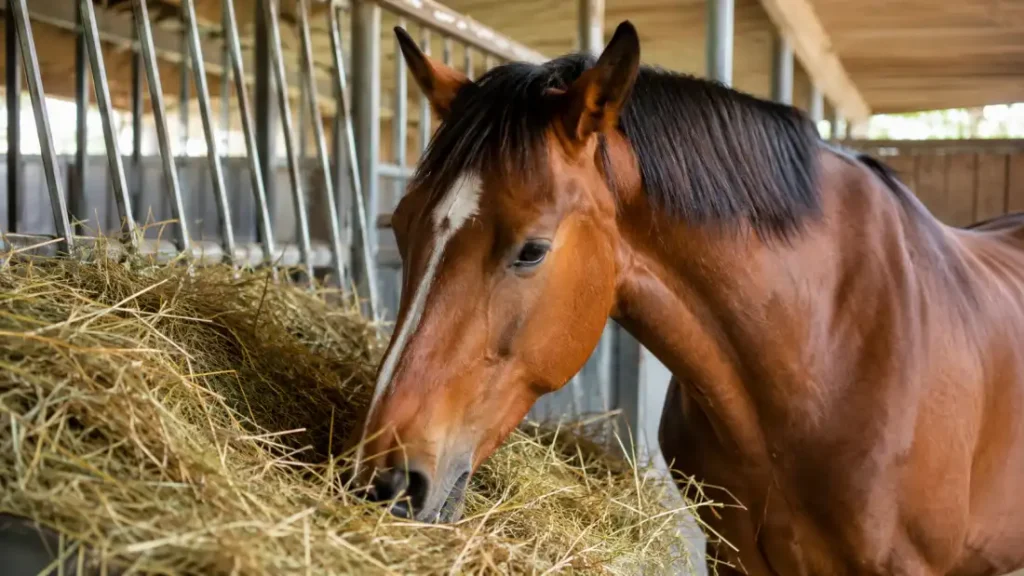
Instead of eating one or two huge meals, they naturally spend many hours eating relatively small amounts of forage.
Hay helps provide:
- Fiber
- Energy
- Protein
- Some vitamins and minerals
- Something to chew throughout the day
More importantly, regular forage intake supports the normal functioning of the horse’s digestive system.
That’s why simply thinking about calories isn’t enough when planning a horse’s diet.
You also need to think about how much forage the horse receives and how often it has access to it.
How Much Hay Does a 1,000-Pound Horse Need?
Let’s use a 1,000-pound horse as an easy example.
At 2% of body weight:
1,000 × 0.02 = 20 pounds of forage per day
So approximately 20 pounds of forage per day can be a useful starting point for a 1,000-pound horse.
But remember that this is not automatically the correct amount for every 1,000-pound horse.
One horse may maintain a healthy weight on less, while another may require more because of workload, age, metabolism or forage quality.
And if the horse also receives pasture, concentrates or other feeds, those need to be considered as part of the overall feeding program.
Does Hay Quality Change How Much a Horse Needs?
Absolutely.
Not all hay contains the same amount of nutrients.
Hay quality can vary depending on:
- Grass or plant species
- Maturity when harvested
- Growing conditions
- Harvesting method
- Storage
- Moisture
- Leaf-to-stem ratio
Two bales can look similar but provide different nutritional value.
This is why forage analysis can be useful when you’re trying to create a precise feeding program.
A horse that maintains weight easily may do well on a lower-energy grass hay, while a horse struggling to maintain weight may need a more nutrient-dense forage or additional feed.
Can a Horse Eat Too Much Hay?
Yes.
Although forage is the foundation of a healthy horse diet, more isn’t always better.
Easy-keeping horses can gain excessive weight when given unrestricted access to rich hay or pasture.
Excess body weight can increase the risk of certain health problems, including laminitis in susceptible horses.
For overweight horses, the goal isn’t simply to stop feeding.
Instead, the feeding plan should maintain adequate forage intake while controlling total calories.
A veterinarian or equine nutritionist can help determine an appropriate program for horses that are overweight or have metabolic conditions.
Can a Horse Eat Too Little Hay?
Yes, and this can be equally problematic.
Horses need adequate forage to support normal digestive function.
Long periods without forage can also encourage unwanted behaviors and may contribute to digestive problems.
That’s why drastically cutting hay to make a horse lose weight isn’t a good approach.
A better strategy is to balance:
- Total forage intake
- Hay quality
- Feeding frequency
- Exercise
- Body condition
- Overall calorie intake
Should Hay Be Available All Day?
It depends on the individual horse and feeding situation.
Some horses can safely have free-choice forage, while others—especially easy keepers—may gain too much weight if unrestricted access is provided.
For horses that need controlled forage intake, slow-feeding hay nets can help extend eating time and reduce how quickly hay is consumed.
This can better mimic the horse’s natural grazing pattern.
How Many Times a Day Should You Feed Hay?
Whenever practical, forage should be offered in a way that avoids unnecessarily long periods without something to eat.
Many owners divide the daily hay allowance into several feedings.
For example:
Morning: 6–7 lb
Afternoon: 5–6 lb
Evening: 7–9 lb
The exact schedule isn’t important as a universal rule. What matters is designing a feeding routine appropriate for the horse, stable setup and total daily ration.
Should You Weigh Horse Hay?
If you’re trying to control your horse’s diet accurately, yes.
This is one of the easiest improvements you can make to your feeding routine.
A “flake” of hay isn’t a standard measurement.
One flake from one bale may weigh very differently from a flake from another bale.
Instead of saying:
“My horse gets four flakes.”
it’s much more useful to know:
“My horse gets approximately 20 pounds of hay.”
A simple hanging scale can make measuring hay much easier.
How Do You Know If Your Horse Is Getting Enough Hay?
Your horse’s body condition is one of the most useful indicators.
Look for:
- Healthy body weight
- Appropriate fat coverage
- Good muscle condition
- Normal energy levels
- Healthy coat
- Normal manure
- No obvious signs of digestive discomfort
However, visual assessment alone isn’t always enough.
A veterinarian or qualified equine nutrition professional can help evaluate body condition and adjust the feeding plan.
Hay vs Grass: Which Is Better?
Both can be excellent sources of forage.
Fresh pasture provides water and nutrients naturally, while hay provides a convenient source of forage when pasture isn’t available.
The important factor is quality and suitability, not simply whether the forage is fresh or dried.
A horse grazing very rich pasture may actually consume more calories than a horse eating moderate-quality grass hay.
What Type of Hay Is Best for Horses?
There isn’t one universally perfect hay.
Common choices include:
- Timothy
- Orchardgrass
- Brome
- Fescue
- Bermudagrass
- Alfalfa
- Mixed grass-legume hay
The best option depends on the horse.
For example, a horse that gains weight easily may do better with an appropriate lower-energy grass hay, while a growing horse or horse with higher nutritional needs may benefit from more nutrient-dense forage.
How Should Hay Be Stored?
Good storage protects hay from moisture, mold and nutrient loss.
Ideally, hay should be:
- Kept dry
- Protected from rain
- Stored off the ground when possible
- Properly ventilated
- Checked regularly for mold or spoilage
Never knowingly feed moldy or spoiled hay to horses.
Can You Feed Hay and Grain Together?
Yes, if the horse actually needs concentrate feed.
However, grain should not automatically be added simply because hay is available.
Many adult horses doing light work or maintenance can meet much of their nutritional needs through forage.
Horses with higher energy requirements may need concentrates.
The complete diet—not one individual feed—should be evaluated.
What About Hay for Horses That Need to Lose Weight?
Weight management can be tricky.
The goal should be to reduce excessive calorie intake without depriving the horse of necessary forage.
Possible strategies may include:
- Measuring hay by weight
- Choosing suitable lower-energy forage
- Using slow-feed hay nets
- Managing pasture access
- Increasing appropriate exercise
- Monitoring body condition
Because overweight horses can have an increased risk of metabolic problems and laminitis, major dietary changes should be discussed with an equine veterinarian.
What About Horses That Need to Gain Weight?
If a horse is underweight, simply giving unlimited grain isn’t necessarily the answer.
First investigate why the horse is losing weight.
Possible factors can include:
- Poor-quality forage
- Dental problems
- Parasites
- Illness
- Insufficient calories
- Competition from other horses
- Stress
- Age-related problems
A veterinarian should evaluate unexplained weight loss.
Once underlying problems have been addressed, the diet can be adjusted using better-quality forage and additional feed where appropriate.
Common Hay-Feeding Mistakes
1. Measuring hay by flakes
Flakes can vary greatly in weight.
2. Changing hay suddenly
Introduce new forage gradually whenever possible.
3. Ignoring hay quality
Nutritional value varies considerably between different hays.
4. Feeding based only on appearance
A horse can look healthy while receiving an unbalanced diet.
5. Cutting forage too aggressively
Weight management still requires adequate forage.
6. Forgetting pasture
Grass intake counts toward the horse’s total forage and calorie intake.
A Simple Hay-Feeding Example
Imagine you have a healthy 1,000-pound adult horse.
A 2% starting point would equal approximately:
20 pounds of forage per day.
If the horse receives:
- 15 pounds of hay
- Several hours of pasture
- Concentrate feed
you can’t simply assume the horse needs another 5 pounds of hay.
The pasture and concentrate are already part of the overall nutritional picture.
This is why a feeding plan should consider everything the horse eats, not just the hay hanging in the stable.
Frequently Asked Questions
How much hay does a horse eat per day?
Many horses consume around 1.5–2.5% of their body weight in forage daily, although individual requirements vary.
How much hay does a 1,000-pound horse need?
Using a 2% starting point, a 1,000-pound horse would receive approximately 20 pounds of forage per day. The appropriate amount depends on the horse and the rest of its diet.
Is 20 pounds of hay enough for a horse?
It may be appropriate for some 1,000-pound horses, but not necessarily for every horse. Body condition, workload, forage quality and other feeds all matter.
Can horses eat too much hay?
Yes. Horses that are easy keepers can gain excess weight when consuming unrestricted quantities of calorie-dense forage.
Should hay be fed by weight?
Yes. Weighing hay is much more accurate than counting flakes because bale flakes can vary significantly in weight.
Is grass better than hay?
Neither is automatically better. Both can provide valuable forage when they are appropriate in quality and quantity for the individual horse.
Do horses need hay every day?
Most horses need daily access to adequate forage. Pasture can provide that forage when suitable, while hay is commonly used when pasture isn’t available.
Hay isn’t just something horses eat when there is nothing else available.
For many horses, forage is the foundation of the entire diet.
The right amount depends on the horse’s body weight, condition, activity level, age, health and the nutritional quality of its forage.
Instead of measuring hay by flakes or guessing how much your horse needs, weigh the forage and monitor the horse’s body condition over time.
And remember: the goal isn’t to feed the most hay possible or the least possible—it’s to provide the right amount of quality forage for that individual horse.
For horses with special dietary needs, unexplained weight changes or health conditions, work with an equine veterinarian or qualified equine nutrition professional.