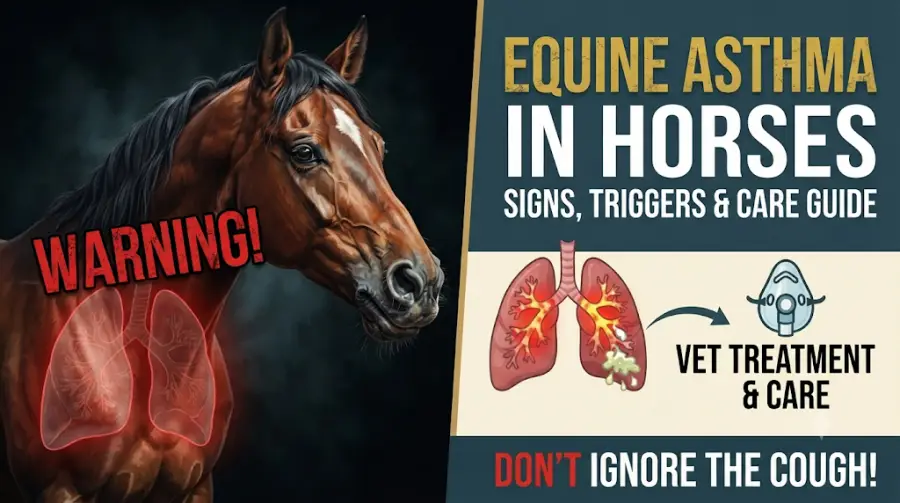
A horse that coughs repeatedly while eating hay, struggles to finish a normal exercise session or breathes harder than usual at rest may have a respiratory problem that deserves attention. One possible cause is equine asthma in horses, a chronic inflammatory condition affecting the lower airways.
Equine asthma is sometimes called heaves, recurrent airway obstruction or inflammatory airway disease. These older terms describe different patterns and levels of severity within a broader group of respiratory conditions.
The problem is not always obvious at first. Some horses develop a persistent cough, while others show only reduced performance during demanding exercise. In more serious cases, breathing becomes visibly difficult even when the horse is standing quietly.
Dust, mould spores and other airborne irritants can contribute to airway inflammation in susceptible horses. This makes stable conditions, bedding choices and forage management important parts of long-term care.
The good news is that many affected horses can be managed successfully with veterinary treatment and appropriate environmental changes. This guide explains the warning signs, possible triggers, diagnosis and practical steps owners can take to support respiratory health.
What Is Equine Asthma?
Equine asthma is a chronic, non-infectious inflammatory disease of the lower respiratory tract. It involves inflammation and increased sensitivity of the airways, which can make it harder for air to move normally through the lungs.
When the airways become inflamed, they may produce excess mucus and narrow in response to irritants. This can cause coughing, reduced exercise tolerance and, in more severe cases, obvious difficulty breathing.
Veterinary terminology generally groups several previously separate conditions under the term equine asthma.
Two broad categories are commonly discussed:
Mild-to-moderate equine asthma: Horses may show occasional coughing, reduced athletic performance or exercise intolerance. They may appear completely normal while resting.
Severe equine asthma: Horses can develop repeated episodes of coughing and noticeable breathing difficulty, sometimes even when they are not exercising. This form was traditionally called heaves or recurrent airway obstruction.
The severity can vary between horses. A horse with occasional coughing may still have meaningful airway inflammation, while another may show more obvious respiratory distress.
Equine asthma is not the same as an ordinary infectious respiratory illness. A horse with asthma does not automatically have a contagious disease, although respiratory infections can occur separately and need their own diagnosis.
Common Signs of Equine Asthma
The signs depend on how severely the airways are affected and what triggers the horse encounters.
Owners should pay attention to changes in breathing, coughing, exercise tolerance and general behaviour.
1. Repeated coughing
A recurring cough is one of the most recognizable signs.
Some horses cough when they begin exercising. Others cough while eating dry hay, during stable cleaning or when exposed to dusty surroundings.
An occasional cough does not automatically mean asthma. Dust irritation, respiratory infections and other conditions can also cause coughing.
However, a cough that continues, returns frequently or becomes more noticeable deserves veterinary investigation.
2. Difficulty breathing
In more severe cases, a horse may show increased breathing effort even while standing at rest.
Watch for:
- Noticeable movement of the abdominal muscles during breathing.
- Flared nostrils.
- Faster breathing than usual.
- Prolonged effort when breathing out.
- A horse that appears uncomfortable while standing quietly.
Visible respiratory distress is not a condition to monitor casually. Contact a veterinarian promptly.
3. Reduced exercise performance
A horse with mild-to-moderate asthma may not show obvious breathing problems in the stable.
Instead, the owner may notice that the horse struggles during exercise, tires earlier or cannot maintain its previous level of performance.
A competition horse might lose speed or stamina. A leisure horse may become reluctant to continue a familiar ride.
These signs can also result from pain, poor fitness, heart problems or other respiratory conditions, so a complete assessment is important.
4. Nasal discharge
Some horses develop mucus in the nasal passages or respiratory tract.
The amount and appearance of discharge can vary. Nasal discharge alone does not identify asthma and may also indicate an infection or another respiratory problem.
Discharge accompanied by fever, reduced appetite or general illness should be discussed with a veterinarian.
5. Wheezing or unusual breathing sounds
Some affected horses produce wheezing sounds as air moves through narrowed airways.
These sounds may be more noticeable during expiration, when the horse breathes out.
A veterinarian can listen to the chest and assess respiratory sounds. Owners should not rely on sound alone to diagnose the condition.
6. A visible heave line
In horses with longstanding severe asthma, the abdominal muscles used for breathing out may become more developed.
This can create a visible line along the lower edge of the rib cage, traditionally called a heave line.
Not every horse with asthma develops this appearance. Its absence does not rule out the disease.
What Causes Equine Asthma?
Equine asthma is associated with inflammation triggered by environmental exposure in susceptible horses.
There is no single cause that applies to every animal. The important issue is identifying which environmental conditions make an individual horse’s symptoms worse.
1. Dust from hay
Dry forage can release tiny airborne particles when it is handled, shaken or eaten.
Even hay that looks clean may contain organic dust, mould fragments and other substances that irritate sensitive airways.
A horse that coughs during feeding or develops worse symptoms inside a hay-filled stable may need a review of its forage and feeding environment.
2. Mould spores
Mould can develop in stored forage and bedding when moisture and storage conditions allow it.
Some mould-related particles can become airborne and reach the lower respiratory tract.
Never feed visibly mouldy or spoiled hay. However, removing obvious mould is not enough to guarantee that the remaining forage is suitable for a horse with respiratory disease.
3. Dusty bedding
Bedding is another possible source of airborne irritants.
Some straw and other organic materials can contain dust, mould and fragments that become airborne when a horse moves around its stable.
A low-dust bedding option may be more suitable for an affected horse, depending on the product, stable conditions and individual response.
4. Poor stable ventilation
A stable with inadequate ventilation can allow dust, moisture and irritating gases to accumulate.
Ammonia from urine-soaked bedding is one example of an airway irritant that can contribute to poor air quality.
Good ventilation should allow fresh air to circulate without creating unsafe conditions or exposing horses to extreme weather.
5. Dust from neighbouring activities
A horse may be exposed to dust even when its own bedding and feed are carefully managed.
Possible sources include:
- Sweeping stable aisles.
- Mucking out nearby stalls.
- Moving dry hay.
- Indoor riding arenas.
- Storing hay above horse accommodation.
- Blowing dust with machinery.
Consider the horse’s entire environment rather than looking only at its own stable.
6. Pasture-related triggers
Not every horse improves simply by moving outdoors.
Some horses experience seasonal respiratory problems associated with pasture environments. Pollen, fungal spores and other airborne material may contribute to symptoms in susceptible animals.
If a horse becomes worse when turned out during a particular season, tell your veterinarian. The management plan may need to be different from that used for a horse whose symptoms are mainly associated with stable dust.
How Is Equine Asthma Diagnosed?
A horse’s cough or breathing pattern can suggest a respiratory problem, but these signs do not confirm asthma.
A veterinarian needs to consider the horse’s history, physical examination and, when appropriate, diagnostic tests.
1. Medical history and physical examination
The veterinarian may ask:
- When did the coughing begin?
- Does it occur during feeding, exercise or rest?
- Is the horse worse inside the stable or outdoors?
- Has the horse recently travelled or attended an event?
- Has there been a change in hay, bedding or stable ventilation?
- Is the horse showing reduced performance?
- Has it had a recent fever or respiratory illness?
The veterinarian will also assess breathing rate, effort, chest sounds and general health.
2. Listening to the lungs
A stethoscope allows the veterinarian to listen for abnormal respiratory sounds.
In some situations, a rebreathing examination may be considered to make subtle lung sounds easier to detect. This is a veterinary procedure and should not be attempted by owners.
A rebreathing examination is not appropriate for a horse already experiencing significant breathing difficulty.
3. Respiratory endoscopy
An endoscope is a flexible instrument with a camera that allows the veterinarian to inspect parts of the respiratory tract.
The examination may reveal mucus accumulation, inflammation or other abnormalities.
It can also help investigate alternative explanations for coughing and reduced performance.
4. Bronchoalveolar lavage
Bronchoalveolar lavage, commonly called BAL, is a diagnostic procedure used to collect fluid from the lower airways.
The sample can be examined for inflammatory cells. The results help veterinarians identify and characterize airway inflammation.
BAL is particularly useful when clinical signs are mild or when a more detailed diagnosis is required.
Not every horse needs every diagnostic test. The veterinarian chooses the appropriate approach based on the horse’s condition and the information needed.
Treatment for Equine Asthma
There is no single treatment plan that works for every horse.
Management depends on disease severity, environmental triggers, diagnostic findings and the horse’s overall health.
1. Reduce exposure to airborne irritants
Environmental management is a central part of treatment.
A horse may improve considerably when exposure to the substances triggering its airway inflammation is reduced.
Possible changes include:
- Moving the horse to a cleaner, better-ventilated environment.
- Reducing dust from forage.
- Changing to suitable low-dust bedding.
- Avoiding dusty indoor arenas.
- Keeping the horse away from stable cleaning activities.
- Reviewing hay storage arrangements.
Medication may control symptoms, but continued exposure to the same triggers can make long-term control difficult.
2. Veterinary-prescribed anti-inflammatory medication
Veterinarians may prescribe corticosteroids to reduce airway inflammation.
Depending on the horse and the clinical situation, these may be given systemically or through an inhalation device designed for horses.
The correct medicine, dose and treatment duration must be determined by the veterinarian.
Corticosteroids can have important side effects. Some horses, particularly those already at risk of laminitis or with certain other health conditions, need additional precautions.
Never use leftover medication or human inhalers without veterinary instructions.
3. Bronchodilators
Bronchodilators help relax airway muscles and improve airflow.
They may provide relief when the airways are narrowed, but they do not replace treatment of the underlying inflammation.
A veterinarian may prescribe a bronchodilator as part of a broader treatment programme.
Using a bronchodilator alone while ignoring environmental triggers is unlikely to provide reliable long-term control.
4. Inhalation therapy
Some medications can be delivered directly into the respiratory tract through equine-specific inhalation equipment.
This approach can help deliver medication to the lungs while limiting some of the systemic exposure associated with certain treatments.
The veterinarian will decide whether inhalation therapy is appropriate and explain how the device should be used.
How to Improve Stable Management for a Horse With Asthma
Changes to daily management can make a significant difference.
The objective is to reduce airborne irritants without creating new welfare or nutrition problems.
Choose suitable bedding
Consider low-dust options such as dust-extracted wood shavings, paper or cardboard products.
The best choice depends on availability, absorbency, cost, drainage and the horse’s individual response.
Avoid assuming that every product marketed as low-dust will be suitable. Observe the horse after changes are made.
Improve ventilation
Fresh air circulation helps reduce the accumulation of airborne irritants.
Where possible:
- Keep ventilation openings clear.
- Avoid blocking airflow with stored materials.
- Remove damp and heavily soiled bedding.
- Maintain a clean stable environment.
- Avoid housing the horse beside dusty hay storage or an indoor arena.
Ventilation should be improved without exposing the horse to dangerous draughts or unsuitable temperatures.
Review the forage
Forage management is particularly important.
Depending on the severity of the disease, a veterinarian or equine nutritionist may recommend soaked hay, steamed hay, haylage or suitable forage alternatives.
Soaking can reduce some airborne dust, but it also affects nutrient content and does not work equally well for every horse.
Steaming may also reduce respirable particles when the correct equipment and process are used.
For severely affected horses, removing conventional hay may be necessary. Any alternative diet must still provide suitable fibre and meet the horse’s nutritional needs.
Never make a sudden major dietary change without professional advice.
Move the horse during stable cleaning
Cleaning, sweeping and moving bedding can create considerable dust.
Where practical, turn the horse out or move it to a clean area while these activities are taking place.
Allow airborne dust to settle and maintain good ventilation before bringing the horse back.
Keep the riding environment clean
An indoor arena can be a significant source of dust, especially when the surface is dry or poorly maintained.
Consider whether the horse’s symptoms are worse after indoor exercise.
Discuss suitable exercise locations and training adjustments with your veterinarian.
Can a Horse With Equine Asthma Still Be Ridden?
Some horses with mild or well-controlled asthma can continue working, but the decision depends on the individual animal.
A horse with active breathing difficulty should not be exercised.
Even when symptoms are subtle, reduced exercise tolerance may indicate that the respiratory condition is not adequately controlled.
Before returning to normal training, ask the veterinarian to assess the horse’s breathing and overall fitness.
The exercise programme may need to be adjusted while treatment and environmental changes take effect.
A horse’s willingness to work should never be used as the only measure of respiratory health. Some animals continue performing despite discomfort.
Is Equine Asthma Curable?
Equine asthma is generally managed as a chronic condition rather than something that can always be permanently cured.
Some horses with mild disease may improve substantially after environmental changes and appropriate treatment.
Severe or longstanding disease can involve structural changes in the airways. These changes may not be reversible.
However, many horses can maintain a comfortable quality of life when their triggers are controlled and their treatment is appropriate.
The aim is to reduce inflammation, improve breathing and prevent repeated flare-ups.
When Should You Call a Veterinarian?
Contact a veterinarian if your horse develops a persistent cough, unexplained loss of performance, recurring nasal discharge or unusual breathing sounds.
Seek urgent veterinary attention if the horse shows:
- Marked difficulty breathing at rest.
- Strong abdominal effort while breathing.
- Severe nostril flaring.
- Rapid deterioration.
- Collapse or extreme weakness.
- Significant distress.
Do not force a horse with breathing difficulty to exercise or walk long distances.
Also, do not assume that every cough is asthma. Respiratory infections, pneumonia, airway obstruction and other conditions can produce similar signs.
Frequently Asked Questions
Is equine asthma contagious?
Equine asthma itself is generally a non-infectious inflammatory condition. It is not spread between horses in the same way as influenza or other contagious respiratory infections.
However, a coughing horse may have a different condition, so veterinary assessment is important.
Can hay cause asthma in horses?
Dust, mould fragments and other organic particles in hay can trigger symptoms in susceptible horses. A veterinarian can help determine whether forage is contributing to the problem.
Is heaves the same as equine asthma?
Heaves is an older term commonly used for severe equine asthma, particularly recurrent airway obstruction. Equine asthma is the broader modern term that includes different levels of disease severity.
Can a horse with asthma live a normal life?
Many affected horses can remain comfortable and active when their disease is appropriately managed. The outcome depends on severity, environmental exposure and response to treatment.
Should I soak hay for a horse with asthma?
Soaking may reduce some airborne dust, but it is not suitable or effective for every horse. It also changes the nutritional characteristics of forage. Ask your veterinarian or equine nutritionist about the best option.
Can outdoor turnout help?
Many horses with stable-associated asthma benefit from more time in a suitable outdoor environment. However, some horses react to pasture-related allergens. The right arrangement depends on the individual horse and its triggers.
Does a horse need medication for life?
Some horses require ongoing medication, while others can be managed with environmental changes and periodic veterinary monitoring. Treatment needs vary according to severity and response.
Equine asthma can affect a horse’s breathing, comfort and ability to exercise. The first signs may be as simple as a recurring cough during feeding or a gradual decline in performance.
Recognizing these changes early gives owners an opportunity to investigate the cause and improve the horse’s environment.
The most effective long-term approach combines veterinary diagnosis, appropriate medication when needed, low-dust forage, suitable bedding and good stable ventilation.
Every horse has different triggers, so management should be based on the animal’s symptoms and professional assessment rather than a universal stable routine.
A clean, well-managed environment and careful observation can make a meaningful difference to the comfort and quality of life of a horse living with asthma.